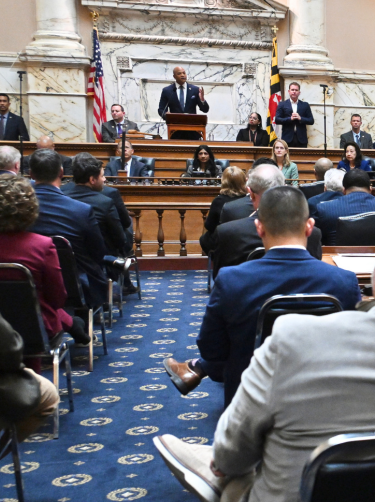
“A lot of people like to talk about how powerful the federal government is, but I need you to remember how powerful we are — state leaders, citizens, people who love our communities, and people who just simply want to make them better,” said Maryland Governor Wes Moore in his remarks. “We’re not going to choose between affordability and innovation — we can and we will lead in both.”
This video features a dozen of the Alliance’s leading governors, including: California Governor Gavin Newsom, Colorado Governor Jared Polis, Connecticut Governor Ned Lamont, Delaware Governor Matt Meyer, Illinois Governor JB Pritzker, Maine Governor Janet Mills, Maryland Governor Wes Moore, Massachusetts Governor Maura Healey, Michigan Governor Gretchen Whitmer, New Mexico Governor Michelle Lujan Grisham, New York Governor Kathy Hochul, and Wisconsin Governor Tony Evers.
In their annual addresses, these Alliance governors spotlight how their states are continuing to cut climate pollution at the same time they are helping lower household energy costs — through energy efficient upgrades, direct energy bill rebates and credits, increased generation of solar and wind power and other clean and reliable energy sources, and more.
“We got the wind power turned back on,” said Connecticut Governor Ned Lamont, who recently celebrated the Revolution Wind offshore wind project delivering its first power to the New England grid. “The turbines are spinning.”
“We need more homegrown energy to lower electricity bills,” said Delaware Governor Matt Meyer in his remarks, underscoring his commitment to expanding renewable energy production. “Affordability depends on increasing our energy supply and becoming more efficient.”
In recent months, other governors across the Alliance have delivered their State of the State addresses and similarly detailed how despite enormous obstacles, their states’ climate solutions are also addressing affordability challenges and rising energy demand. These include:
- Arizona Governor Katie Hobbs, who outlined how Arizona is working to lower energy costs by helping working class families weatherize their homes and pay their utility bills, and is also boosting resilience by securing and conserving state water supplies.
- Guam Governor Lou Leon Guererro, who highlighted improvements to Guam’s power system that have reduced dependence on oil generation, improved efficiency, and allowed greater use of alternative energy.
- Hawaiʻi Governor Josh Green, who urged continued action on conservation and wildfire mitigation and highlighted Hawaiʻi’s first-in-the-nation “Green Fee,” which will unlock millions of dollars annually for climate action.
- Pennsylvania Governor Josh Shapiro, who called for data centers to commit to the highest environmental protection standards and detailed how his Lightning Plan will streamline permitting and siting, generate more renewable energy, and create 15,000 jobs.
- Rhode Island Governor Dan McKee, who addressed federal interference with Revolution Wind and committed to standing shoulder-to-shoulder with fellow governors to defend the project against future attacks.
- Washington Governor Bob Ferguson, who highlighted investments in advancing sustainable aviation fuel and expanding a state-run program that helps Washingtonians pay their utility bills and move to low-to-no carbon heating and cooling options.
As detailed in the Alliance’s annual report, these and other actions are delivering real results, with U.S. markets continuing to rapidly transform toward cleaner energy and cleaner technologies like heat pumps, electric vehicles, and rooftop solar. In fact, clean energy accounted for over 90 percent of all new electricity capacity added to America’s grid in 2025 — enough electricity to power nearly 7 million homes — and nearly two-thirds of electricity generation expected to come online through 2031 will be powered by solar and wind.
“It’s an all-hands-on-deck, comprehensive effort to lead the nation and the world — to make our air cleaner, our water safer, our energy costs affordable, and our communities more resilient,” said New Mexico Governor Michelle Lujan Grisham in her State of the State speech. “And to prove that bold leadership, which we do over and over again together, gets results.”
The video released today can also be viewed on Instagram, LinkedIn, Bluesky, and X/Twitter.
