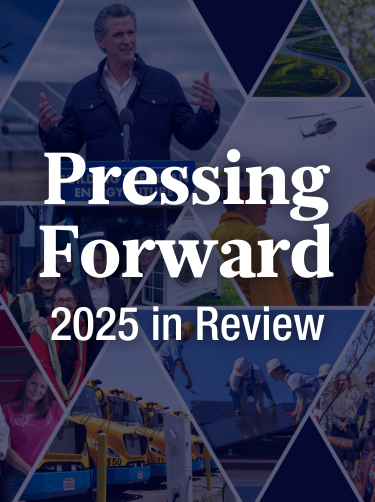
This year, the Alliance welcomed new governors and new leadership to the coalition, resolutely defended America’s progress, delivered results and advanced state-led climate action, launched new initiatives to save consumers money through clean energy and clean cars, and sustained and strengthened America’s leadership on the global stage.
Below, we highlight a few of these key moments.
Welcoming New Governors and New Leadership
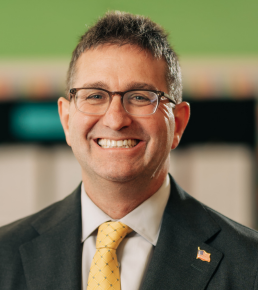
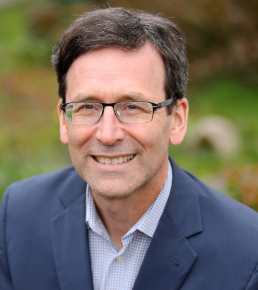
As we kicked off 2025, we had the privilege to officially welcome three new governors to the Alliance — Governor Bob Ferguson of Washington, Governor Matt Meyer of Delaware, and Governor Josh Stein of North Carolina. Each of these governors continued their state’s membership in our coalition. We also took a moment to acknowledge the incredible contributions of the governors that preceded these new members, including paying tribute to Governor Jay Inslee, who helped launch our coalition back in 2017.
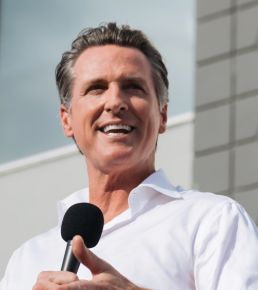
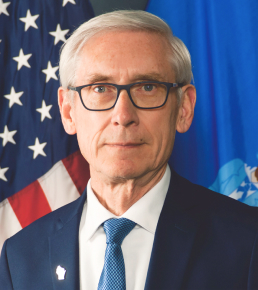
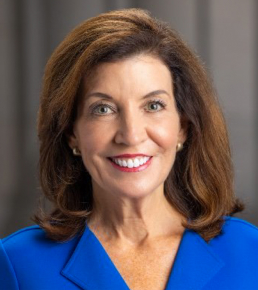
This year, we were also thrilled to announce the appointment of California Governor Gavin Newsom and Wisconsin Governor Tony Evers as the new co-chairs of the Alliance. Together with New York Governor Kathy Hochul, Delaware Governor Matt Meyer, and Washington Governor Bob Ferguson, they steer the Alliance’s executive committee charged with overseeing the strategic direction of our coalition. This year is the first the Alliance has been co-chaired by a Midwest governor.
Defending America’s Progress
As our governors have continued to respond to the climate crisis and its devastating impacts on our communities, they’ve also been forced to confront a federal government intent on reversing America’s progress. This could have knocked us back and diminished our ambitions, but instead, it has only fortified our bonds and catalyzed new action.
As the year kicked off, we made our intentions crystal clear, vowing to advance climate action no matter the headwinds. This resolve was on full display as our governors laid out their agendas for 2025 in State of the State and budget addresses. Throughout the year, the Alliance stepped up and stood tall to protect our progress, including against efforts to: undermine state authority, eliminate the Solar for All program, repeal a longstanding determination on the causes and harms of climate change, pass an anti-climate megabill, roll back federal pollution standards for fossil fuel-fired power plants, end the federal Greenhouse Gas Reporting Program, halt state-led clean vehicle programs, and weaken federal fuel economy standards, among other harmful actions.
The Alliance also committed to housing and sustaining work on two initiatives our states launched in partnership with the previous administration — the State Buy Clean Partnership and State Modern Grid Deployment Initiative.
Delivering Results & Advancing Action
As we defended our progress, Alliance states pressed forward to continue delivering a cleaner, healthier, and safer future for Americans. During Climate Week NYC, we announced our coalition has collectively reduced net greenhouse gas emissions 24 percent below 2005 levels, far outpacing the rest of the country and putting us within reach of our near-term climate goal. At the same time, we’ve increased GDP across the Alliance by 34 percent — making clear what we already know: climate action and economic growth go hand-in-hand.
New data, included in our Annual Report, also showed that achieving our climate pollution reduction goals would save Americans $11 billion per year by 2030, rising to $185 billion annually by 2050. That’s trillions of dollars in cumulative net benefits for Americans in the years ahead if we can sustain our momentum. Critically, we identified a collective pathway to help us do just that — overcome the federal government’s inaction and continue driving deep emissions reductions through the broad adoption of impactful policy solutions, which are already being developed or implemented in many Alliance states.
We’ve highlighted these state-led solutions in a number of ways throughout the year, most notably through a video series spotlighting game-changing leadership and action from our governors. This included videos showing how: Maine Governor Janet Mills is transforming America one heat pump at a time; Oregon Governor Tina Kotek is building community resilience through climate action; and Wisconsin Governor Tony Evers is protecting our future through nation-leading conservation efforts. These are just a few of the more than 2,300 bold actions and innovative policies our members have advanced since the Alliance was launched more than eight years ago.
The Alliance Secretariat also continued to provide a broad range of technical, analytical, policy, and capacity assistance to coalition members this year. This support included organizing “Learning Labs” to advance how we quantify and model greenhouse gas in natural and working lands and integrate climate considerations in land use planning, building on the Climate and Land Use Planning Guide we released earlier in the year.
Additionally, we convened our governors’ offices for a series of interactive, hands-on sessions and discussions at our multi-day Semiannual Meetings in Washington, D.C. and Madison, WI, and we brought our own team together in Boston, MA with Governor Maura Healey and dozens of top officials across state government to continue exploring ways to advance state-led climate action.
Saving Consumers Money with Clean Energy and Clean Cars
Boosting affordability through clean energy remained a key priority for us, and we launched several new infinitives to help Americans lower their costs this year. This included founding the Affordable Clean Cars Coalition to sustain America’s transition to cleaner and more affordable cars, support U.S. automotive manufacturers and workers, and preserve states’ clean air authority. Alongside the launch, the Alliance announced the availability of resources to help states tackle vehicle pollution and lower barriers for consumers to more affordably own, drive, charge, and maintain clean cars. In the face of a series of destabilizing actions from Congress and the federal government, this 13-state effort has underscored our governors’ commitment to both consumer choice and regulatory certainty and stability for the U.S. automotive sector.

In 2025, we also joined with Climate Mayors, a bipartisan network of nearly 350 mayors representing 46 states, to launch a nationwide effort to encourage Americans to take advantage of cost-saving federal clean energy tax credits before they expire. Through the end of the year, states and cities across the two coalitions have continued to engage consumers and businesses to ensure they take advantage of these federal incentives, while continuing to offer a suite of state and local incentive programs to support the transition to clean energy solutions.
Sustaining and Strengthening America’s International Leadership
In the absence of federal climate leadership, the Alliance once again stepped up to fill the void on the global stage this year. In fact, as the Trump administration announced it would withdraw the U.S. from the Paris Agreement, the co-chairs of the U.S. Climate Alliance delivered a letter to UN Climate Change Executive Secretary Simon Stiell making clear to the global community that climate action would continue in the U.S.
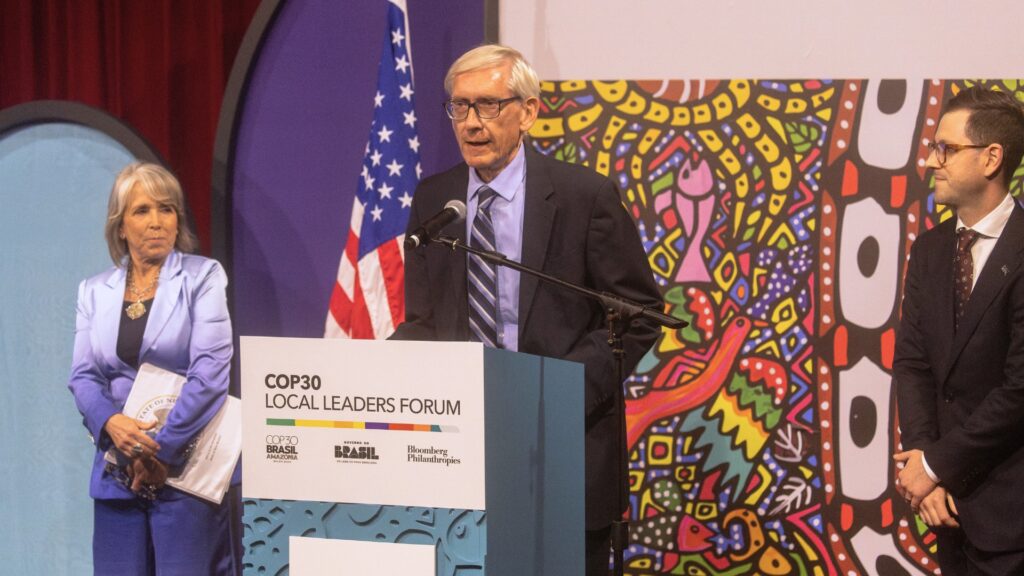
As part of that letter, our governors committed to tracking and reporting on their progress to the international community, including at the UN Climate Change Conference in Brazil (COP30) — and that’s exactly what we did. In November, the Alliance teamed up with America Is All In and Climate Mayors to lead a U.S. delegation of more than 100 local officials to the COP30 Local Leaders Forum in Rio de Janeiro and COP30 in Belem. At these convenings, we released new data showing sustained U.S. momentum, and we shared solutions, forged bonds, and identified strategies to accelerate progress with partners around the world. We were represented at COP30 by Alliance co-chairs California Governor Gavin Newsom and Wisconsin Governor Tony Evers and past co-chair New Mexico Governor Michelle Lujan Grisham, alongside top state officials from Colorado, Maryland, and New York.
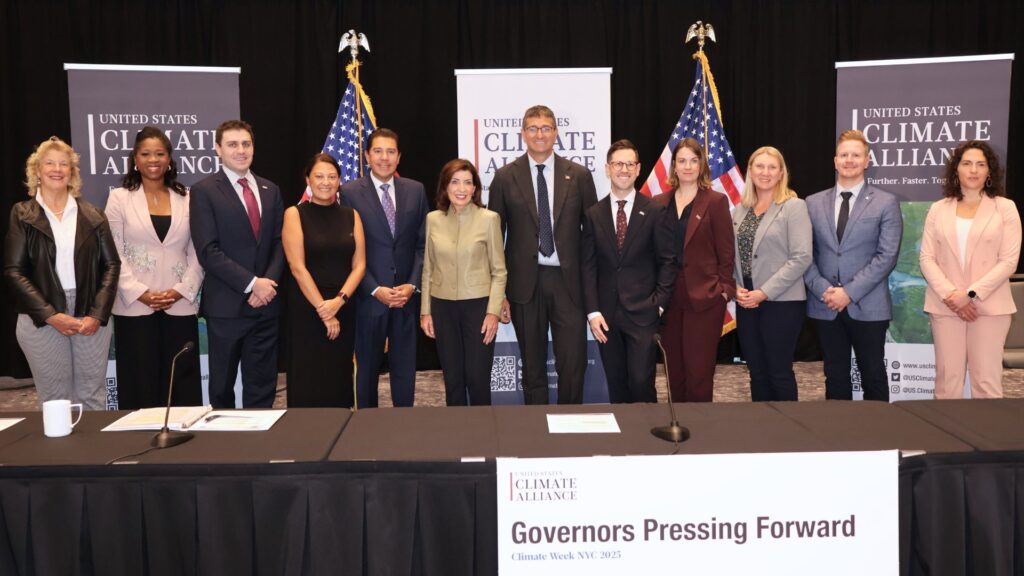
In 2025, our members have set new and increasingly ambitious targets and adopted new laws and regulations across every sector. They’ve invested billions of dollars in climate mitigation projects and advanced new tools and strategies to bolster resilience, boost affordability, and cut pollution. They are getting more heat pumps into homes and businesses, more registered apprentices into good-paying careers, more electric vehicles and chargers on our roads, more solar panels on our roofs, and more clean, cheap, and locally available energy on our grid.
The sustained action across our coalition this year should make it clear that we’re not going anywhere — and we look forward to building on this tremendous progress in 2026. For more, follow us on Instagram, Bluesky, LinkedIn, and X/Twitter.
